Morocco Visa Guide: German citizens do not need a visa for stays in Morocco up to 90 days – the passport must be valid for at least 6 months. For longer stays, the E-Visa (from 22 EUR, online) and the embassy visa (40-80 EUR) are available. This guide shows all options, costs, duration, and step-by-step instructions.
Last updated: July 2026 | Author: visum-marokko.de Editorial Team — Experienced travel and immigration experts specializing in North African immigration law
Morocco Visa at a Glance
| Question | Short Answer for German Travelers |
|---|---|
| Visa for holiday or business trip? | Not required for stays up to 90 days |
| Travel Document | Machine-readable passport with at least 6 months validity remaining – national ID card is not sufficient |
| Entry Form | Landing Card on the plane or at the border counter, in English or French |
| Stay over 90 days | Extension before expiry date at the Aliens Police in Morocco or appropriate visa |
| E-Visa | Online application via the Accès Maroc portal, primarily for visa-required nationals |
| Responsible Representations | Embassy Berlin, Consulates General Düsseldorf and Frankfurt am Main |
The following sections explain each point in detail – from visa requirements to the E-Visa and the responsible embassy.
Do I need a visa for Morocco?
German citizens do not need a visa for tourist and business stays in Morocco up to 90 days – a valid passport is sufficient. This is the short answer to the most common question from German travelers. Anyone traveling to Morocco as a tourist or for business appointments can enter without a visa, provided the stay does not exceed 90 days.
However, if you wish to stay longer, you will need a visa. The Moroccan authorities strictly control compliance with deadlines. Overstaying the visa-free period is punishable and can lead to refusal of departure. In the worst case, a fine or an entry ban may be imposed.
Important: The German national ID card is not sufficient for entry into Morocco. You absolutely need a valid, machine-readable passport. More on the exact entry requirements for Morocco can be found in our separate guide.
Visa Requirement by Nationality
Visa-free entry applies equally to citizens of DACH countries:
| Country | Visa Requirement | Maximum Duration of Stay |
|---|---|---|
| Germany | No | 90 days |
| Austria | No | 90 days |
| Switzerland | No | 90 days |
The same conditions apply to all three countries: tourist or business stays up to 90 days within 180 days are possible without a visa. For citizens of other countries, a visa requirement may exist – checking with the Moroccan embassy is recommended here.
Passport Requirements
For visa-free entry into Morocco, the passport must meet the following criteria:
- Be machine-readable (all current German passports meet this)
- Have at least 6 months validity remaining from the date of entry
- Have at least 1 blank page for the entry stamp
- Children’s passports are accepted
- The national ID card is NOT accepted
If your passport is valid for a shorter period, you should apply for a new one in good time. The processing time for German authorities is usually 4-6 weeks.
Morocco Entry Form: What is asked?
German tourists do not need a visa, but they do need the entry form (Landing Card): It is submitted at border control with the passport upon every entry. Usually, the crew distributes the card during the flight, or it is available at the border counter. There is no German version, only English and French.
On the card, you enter your name as it appears in your passport, date of birth, nationality, passport number, occupation, the address of your accommodation in Morocco, the date of return or onward travel, and the flight number. Your own ballpoint pen in your hand luggage saves time in the queue. All information and tips for filling out the form can be found in the section Filling out the Entry Form (Landing Card) of our entry guide.
What types of visas are available for Morocco?
Morocco offers four visa types – tourist visa, business visa, transit visa, and study and work visa – with different requirements and durations of stay. The choice of the correct visa depends on the purpose of stay and the planned duration. For most German tourists, no visa is necessary anyway, as the 90-day rule is sufficient.
However, if you wish to stay in Morocco for more than 90 days or are entering from a visa-required country, you must apply for the appropriate visa. The following overview shows all options in comparison:
| Visa Type | Purpose | Duration | Cost |
|---|---|---|---|
| Tourist Visa | Holiday over 90 days | Up to 90 days (extendable) | 40-80 EUR |
| Business Visa | Business stays | Up to 90 days (extendable) | 40-80 EUR |
| Transit Visa | Transit | Up to 72 hours | 20-40 EUR |
| Study Visa | Study/Training | According to duration of study | 40-80 EUR |
Tourist Visa
The tourist visa is intended for travelers who wish to stay in Morocco for longer than 90 days or who come from a country that is not allowed visa-free entry. It is applied for at the Moroccan embassy or via the E-Visa portal. Detailed information on the tourist visa for Morocco can be found in our special article.
Business Visa
The business visa is for travelers who are engaged in business activities in Morocco – for example, for meetings, conferences, trade contacts, or projects. It requires additional documents such as an invitation from the Moroccan business partner. For stays under 90 days, no visa is required here either. More about the Morocco Business Visa in our detailed guide.
Transit Visa
The transit visa is intended for travelers in transit who do not leave the Moroccan airport. It is valid for a maximum of 72 hours. For German citizens, a transit visa is generally not necessary, as visa-free entry also covers transit.
Study and Work Visa
Anyone wishing to study or work in Morocco needs a special visa. This is applied for at the Moroccan embassy and requires an admission certificate from the Moroccan educational institution or an employment contract. After entry, a residence permit must be applied for at the Aliens Police.
Morocco E-Visa: Apply Online
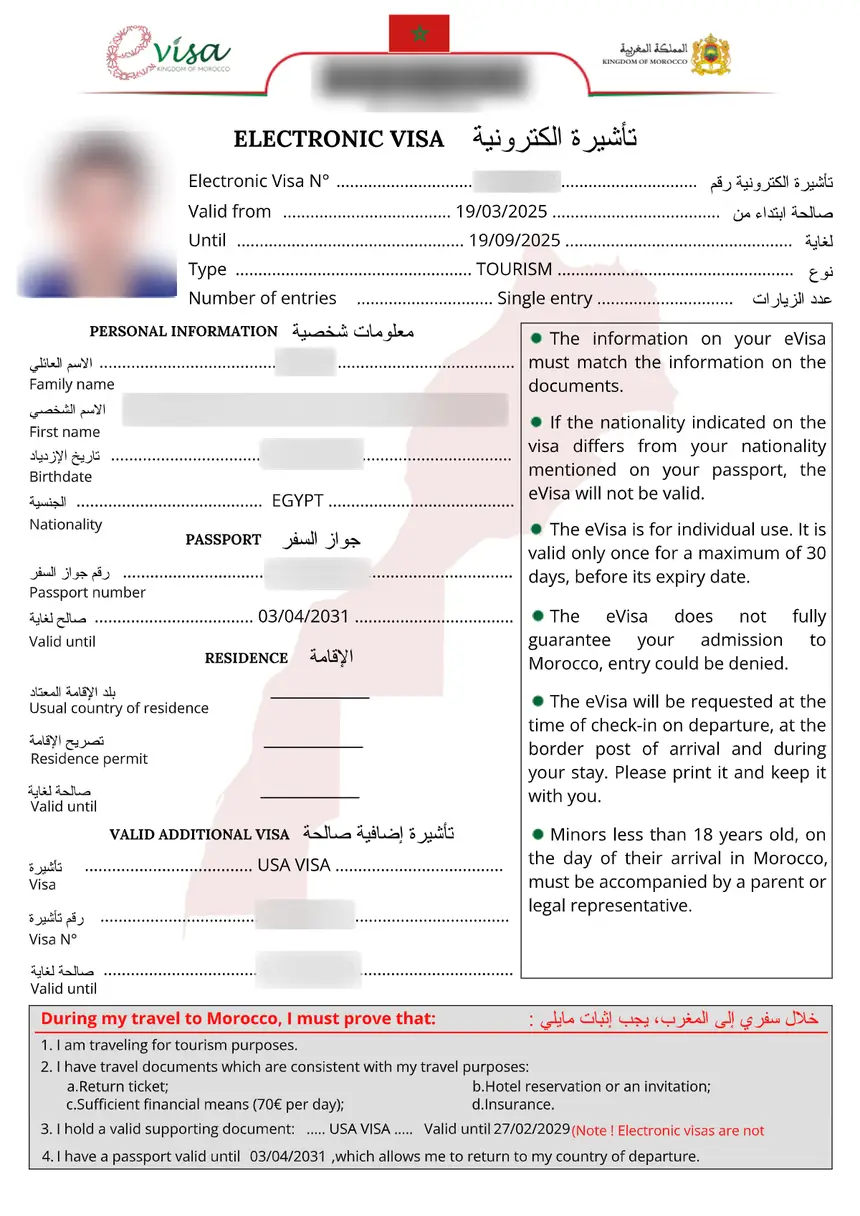
The Moroccan E-Visa costs from 22 EUR, is applied for entirely online via acces-maroc.ma, and is usually approved within 48 hours. The E-Visa is the easiest and fastest option for anyone who needs a visa for Morocco. It was introduced to simplify the application process and reduce waiting times at the embassy.
The E-Visa is available for certain nationalities, including German citizens. It allows a stay of up to 30 days and can be extended once for another 30 days. The validity is 180 days from the date of issue.
Step-by-Step Guide
How to apply for your Morocco E-Visa online:
- Open Portal: Visit the official website acces-maroc.ma
- Select Nationality: Choose your nationality and purpose of travel
- Fill out Form: Enter your personal data, travel data, and passport data
- Upload Documents: Upload a scan of your passport and a passport photo
- Pay Fee: Pay the visa fee by credit card (from 22 EUR)
- Receive Confirmation: You will receive a confirmation email with your application number
- Print E-Visa: After approval (approx. 48 hours), you can print the E-Visa and present it upon entry
Tip: Apply for the E-Visa at least 2 weeks before your trip to cushion any delays. The E-Visa for Morocco is one of the fastest visa options worldwide. Detailed information on the Morocco E-Visa can be found in our special article.
AEVM – Electronic Travel Authorization
The AEVM (Autorisation Électronique de Voyage pour le Maroc) is an electronic travel authorization specifically developed for Moroccan citizens abroad. It allows entry without a visa application at the embassy.
The difference to the E-Visa: The AEVM is aimed at Moroccan dual nationals who do not possess a Moroccan passport but wish to enter with a CNIE (Moroccan identity card). German citizens without Moroccan nationality do not need this regulation – for them, the E-Visa or visa-free entry is the correct option.
Morocco Visa Costs: What do you really pay?
An E-Visa for Morocco costs from 22 EUR online, an embassy visa 40-80 EUR – plus possible postage and service fees of up to 30 EUR. Costs vary depending on the application method and can increase due to additional fees. A precise comparison is worthwhile.
The following table shows all costs at a glance:
| Application Type | Visa Fee | Additional Fees | Total Costs |
|---|---|---|---|
| Visa-free (up to 90 days) | 0 EUR | – | 0 EUR |
| E-Visa (online) | 22 EUR | – | 22 EUR |
| Embassy Visa | 40-80 EUR | Postage 5-15 EUR | 45-95 EUR |
| Visa Service | 40-80 EUR | Service fee 20-30 EUR | 60-110 EUR |
Additional costs may arise for:
- Passport photos: 5-15 EUR (if not available)
- Postage/Courier: 5-15 EUR for sending to the embassy
- Certifications: 10-20 EUR depending on the document
- Visa service providers: 20-30 EUR service fee
Payment methods: The E-Visa is paid by credit card. At the embassy, cash payment or bank transfer is accepted. A detailed cost overview can be found in our article on Morocco Visa Costs.
Processing Times: How long does it take?
The E-Visa for Morocco is usually processed within 48 hours, an embassy visa takes at least 15 working days – timely application is crucial. Processing time is an important factor in travel planning. Those who apply too late risk a delayed approval.
| Application Type | Processing Time | Recommended Lead Time |
|---|---|---|
| E-Visa (online) | 24-48 hours | 2 weeks |
| Embassy Visa | 15 working days | 6-8 weeks |
| Express Processing | 5-10 working days | 4 weeks |
Recommended lead time: Apply for the visa at least 1-2 months before your trip. An application can be submitted a maximum of 6 months before the planned travel date.
Special cases: During high season (summer, Ramadan), processing time may take longer. Always plan a time buffer of 2-3 weeks for embassy applications. More details on processing times for Morocco visas can be found in our special article.
Applying for a Morocco Visa: All Methods Compared
Those entering Morocco can apply for a visa in three ways – online as an E-Visa, in person at the embassy, or through a visa service – with different costs and processing times. The choice of application method depends on your purpose of travel, nationality, and personal preferences.
| Application Method | Cost | Duration | Effort |
|---|---|---|---|
| E-Visa online | 22 EUR | 48h | Low |
| Embassy | 40-95 EUR | 15 working days | Medium |
| Visa Service | 60-110 EUR | 10-15 working days | Low |
Recommendation: For most travelers, the E-Visa is the best choice – it is inexpensive, fast, and convenient to apply for from home. The embassy visa is only worthwhile for special visa types or if the E-Visa is not available. Detailed information on applying for a Morocco visa can be found in our comprehensive guide.
Online via E-Visa Portal
The fastest way to get a visa is the E-Visa via acces-maroc.ma. The entire process takes a maximum of 15 minutes and the result is available in 48 hours. Advantages: no postage, no embassy visits, available 24/7.
In Person at the Embassy
For certain visa types or if the E-Visa is not available, you can apply in person at the Moroccan embassy. Appointments are made via the TLScontact system. Bring all original documents and allow for waiting times.
Through a Visa Service
Visa service providers handle the entire application process for you. Advantages: convenience, no embassy visits. Disadvantages: higher costs (20-30 EUR service fee). Attention: Choose only reputable providers and avoid excessive fees.
Document Checklist: What do I need?
For a Morocco visa, at least six documents are required: valid passport, passport photo, application form, proof of funds, return travel booking, and hotel reservation. The complete document list depends on the visa type and application method.
| Document | Required? | Note |
|---|---|---|
| Passport | Yes | Min. 6 months validity, 1 blank page |
| Passport photo | Yes | Biometric, current (not older than 6 months) |
| Application form | Yes | Completed and signed |
| Proof of funds | Yes | Bank statement for the last 3 months |
| Return travel booking | Yes | Flight ticket or travel confirmation |
| Hotel reservation | Yes | Confirmation for the entire duration of stay |
| Invitation letter | For business visa | From the Moroccan business partner |
| Study certificate | For study visa | Admission from the Moroccan university |
| Employment contract | For work visa | From the Moroccan employer |
| Travel insurance | Recommended | Coverage for medical emergencies |
For the E-Visa, digital copies (scans) of the documents are sufficient. For the embassy visa, originals are submitted by mail or in person at the embassy.
Morocco Embassy Germany: Addresses and Contacts
For visas, passports, and certifications in Germany, the Moroccan Embassy in Berlin and the Consulates General in Düsseldorf and Frankfurt am Main are responsible – which representation depends on the federal state of your residence.
| Representation | Address | Responsible for, among others |
|---|---|---|
| Embassy Berlin | Niederwallstraße 39, 10117 Berlin | Berlin, Brandenburg, Hamburg, Bremen, Lower Saxony, and other northern and eastern German states |
| Consulate General Düsseldorf | Cecilienallee 14, 40474 Düsseldorf | North Rhine-Westphalia |
| Consulate General Frankfurt am Main | Ostparkstraße 35, 60385 Frankfurt am Main | Hesse, Baden-Württemberg, Bavaria, Rhineland-Palatinate, Saarland |
Appointments at the embassy and consulates general are booked online via consulat.ma. Honorary consulates (Bremen, Kassel, Tutzing) only handle simple matters such as certifications. Phone numbers, opening hours, and the complete assignment of all federal states can be found on our page Moroccan Embassy and Consulates in Germany.
Note: For a visa to Morocco, the German Embassy in Rabat is not responsible, but rather the Moroccan representation in Germany.
Extending a Visa and Solving Problems
Anyone wishing to stay in Morocco for more than 90 days must apply for an extension at the Aliens Police before the deadline expires – overstaying is punishable. Extending the stay is possible but requires certain conditions and should be applied for in good time.
Stay over 90 days
Anyone wishing to extend their stay in Morocco beyond 90 days must observe the following steps:
- Observe deadline: Submit the application at least 2 weeks before the 90-day period expires
- Responsible authority: Aliens Police (Police des Étrangers) at the place of residence
- Required proofs: Passport, return ticket, proof of funds, proof of accommodation
- Costs: The extension fee is approx. 100-200 MAD
- Duration of extension: Usually another 90 days, maximum 180 days per year
Attention: Overstaying without an extension is punishable and can lead to a fine, an entry ban, or even refusal of departure. More on visa extension in Morocco in our special article.
Visa Rejected – What to do?
A visa rejection happens, but it’s not the end of the world. Common reasons for rejection are:
- Incomplete documents – missing or uncertified documents
- Invalid passport – expired or without sufficient remaining validity
- Missing proof of funds – insufficient means for the stay
- Missing return travel booking – no proof of planned departure
Possible solutions: Check the reasons for rejection, supplement missing documents, and submit a new application. An appeal is possible depending on the application method. If necessary, consult a specialized lawyer. Detailed information on visa rejection in Morocco can be found in our guide.
Special Regulations
For dual nationals, families with children, business travelers, and travelers with special baggage requests, specific regulations apply in Morocco that go beyond the standard visa. These regulations are particularly important for certain travel groups and are often overlooked.
Dual Nationals (CNIE)
Moroccan-German dual nationals have a special status. They need the CNIE (Carte Nationale d’Identité Électronique) – the Moroccan identity card – for entry into Morocco. The advantage: they can enter with both their German passport and their CNIE.
Important: The return of the Moroccan passport does not mean a loss of Moroccan nationality. Dual nationals can continue to enter and exit with the CNIE. The CNIE must be valid and will be checked upon entry.
Traveling with Children and Minors
Special regulations apply to families with children:
- Own children’s passport is mandatory – entry in parent’s passport is not sufficient
- Consent form from the non-traveling parent for single-parent travel
- Birth certificate as proof of kinship
- Certification of the consent form recommended
Attention: Moroccan authorities strictly control these documents, especially upon departure. Missing documents can lead to refusal of departure.
Currency Regulations
Morocco has strict currency regulations:
- Declaration requirement: Cash amounts from 100,000 MAD (approx. 9,000 EUR) must be declared upon entry
- Maximum cash import: 2,000 MAD in cash may be imported and exported
- Currency: Moroccan Dirham (MAD) – 1 EUR = approx. 11 MAD (exchange rate may vary)
Tip: Use credit cards or traveler’s checks as an alternative to cash. Many hotels and restaurants accept international credit cards.
Vehicle Import and Customs
Anyone wishing to enter Morocco with their own vehicle must observe the following regulations:
- Re-export obligation: The vehicle must be re-exported after the stay
- Green Card: A valid international insurance is mandatory
- Customs allowance: 2,000 MAD for goods not to be re-exported
- Vehicle registration document: The original vehicle registration document must be carried
Attention: Anyone who does not re-export the vehicle on time risks a penalty payment. Keep all customs documents carefully.
Frequently Asked Questions (FAQ)
Do I need a visa for Morocco?
How much does a visa for Morocco cost?
How long does it take to process a Morocco visa?
Can I extend the Morocco visa locally?
What to do if my Morocco visa was rejected?
Do children need their own visa for Morocco?
What is the E-Visa for Morocco?
Do I have to declare foreign currency upon entry into Morocco?
Can I take a drone to Morocco?
Do I need a form for entry into Morocco?
Which Moroccan embassy is responsible for me?
The most frequently asked questions about the Morocco visa – answered briefly and precisely for quick orientation.
Further Guides on Morocco
- Entry Morocco: all entry requirements
- Apply for Morocco E-Visa online
- Apply for a visa for Morocco
- Morocco Visa Costs
- Morocco Business Visa
- Extend Morocco Visa
- Moroccan Embassy and Consulates
- Morocco Travel Advice and Safety
- Travel Insurance for Morocco
- Vaccinations for Morocco
- Plan a Morocco Holiday
Note: The information in this article is based on the current entry regulations of the Moroccan authorities (as of: July 2026). For binding information, please contact the Moroccan Embassy in Berlin or the official E-Visa portal acces-maroc.ma directly. This article does not replace individual legal advice.
Sources:
- Federal Foreign Office — Travel and Security Advice Morocco
- Moroccan Embassy Berlin — Visa Information
- Official E-Visa Portal acces-maroc.ma
- Consulates General of the Kingdom of Morocco in Düsseldorf and Frankfurt am Main